

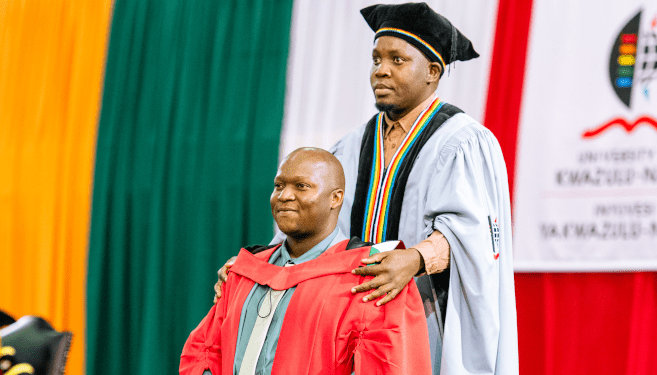
Widespread drug use by young people with very few visible interventions to address this problem within communities motivated Dr Sphesihle Hlongwane to undertake research in this area. He received a PhD in Population Studies for his thesis titled: “Unpacking the Relationship between Drug Use and Health-seeking Behaviour in Young People in an Urban Township in South Africa”.
The study unpacks the individual, community, and structural drivers of substance use and the patterns of health seeking behaviour. Using an evidence-based rationale, he identified appropriate interventions.
‘Substance use is rife in the township of Inanda where I grew up,’ said Hlongwane. ‘In such a setting, it is paramount to understand the contextual factors that influence an individual’s perceived eligibility to seek rehabilitation. My work explores how situational factors influence this perceived eligibility among people with substance use disorder (SUD).’
The study found that context-specific variations determine how drug users frame their experience of addiction. Hlongwane also found that while urban areas are associated with better service delivery, those relating to substance use – including rehabilitation centres – are limited, which impacts users’ decisions to seek rehabilitation.
Substance users are aware of their drug use habits, acknowledge their eligibility for health services, and are willing to quit if assistance is provided. However, the use of healthcare services is hindered by individual determination to quit after long-time use. Drug relapse, though avoidable, is part of the journey to recovery.
The lack of institutional and outpatient support for both substance users and family members makes relapse a possibility for rehabilitated drug users, especially after they return to the social and environmental conditions that enabled their addiction.
Hlongwane noted: ‘Improving the health-seeking behaviour of drug users requires the co-creation of drug use interventions centred on differentiated tailor-made psychosocial support for both them and their families that will facilitate individual support after drug rehabilitation and reintegration into society.’
Whilst his PhD journey was challenging, it was also the realisation of a dream. ‘One of the most profound experiences was attending writing retreats and the opportunity to engage others on my work. My supervisor Professor Pranitha Maharaj played an enormous role in this and motivated me constantly. For this I wish to extend my deep gratitude,’ Hlongwane said.
Maharaj said, ‘Sphesihle submitted an exceptionally well-researched and interesting doctoral study on drug use. I would like to acknowledge his contribution to understanding the experiences of drug users in navigating drug rehabilitation and health-seeking behaviour. I strongly believe that his research is going to have important policy implications.’
He also thanked his family for their support. ‘I am so excited to have attained this momentous accomplishment. My hope is that my study will help to conceptualise tailor-made drug use interventions for young people and the implementation of a psychosocial support programme for users.’