

Life-saving medication is often the difference between life and death. The growing market for counterfeit pharmaceutical products – dangerous, sub-standard drugs – is not just a health concern but a lucrative and thriving criminal enterprise, endangering countless lives.
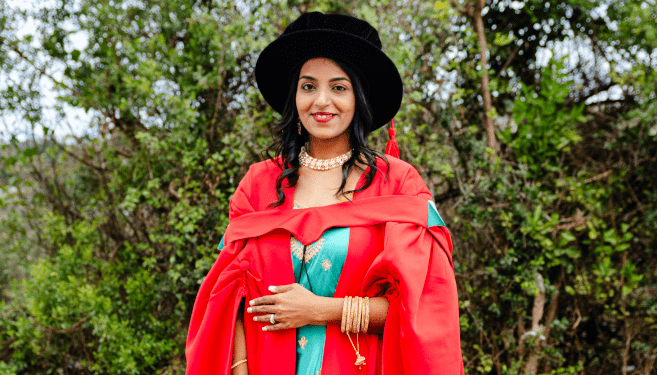
PhD graduate Dr Trevonia Nihal confronted this hidden epidemic head-on in her thesis, “Counterfeit Pharmaceutical Products in South Africa: A Criminological Perspective”. Her research revealed how organised crime, porous and weak border security, a lack of law enforcement and ultimately a market of desperate consumers are fuelling the counterfeit drug trade, with public safety at risk.
The study offers critical insights into the public health risks associated with counterfeit drugs and suggests measures for policymakers and law enforcement to mitigate this growing threat.
Nihal’s study began during the onset of the COVID-19 pandemic. ‘At that time, there was huge scepticism surrounding the authenticity of the vaccines, and the media continuously documented seizures of counterfeit pharmaceutical products,’ she recalls.
The combination of fear, uncertainty, and the rampant circulation of counterfeit drugs during lockdowns inspired her to apply a criminological lens to the issue. ‘I asked, “where does it come from?”, “how safe is it?”, and “what punishment are those being caught receiving?” My criminological passion kicked in, and I knew I had identified a niche that required further research.’
The research uncovered the intricate operations of organised criminal groups responsible for the manufacturing and trafficking of counterfeit medicines in a global network. These are complex networks, with different actors playing specialised roles.
‘While the kingpin plays the major role and may be in a different country altogether, there are a series of individuals that are all tasked differently. Some are responsible for the cross-border transportation of counterfeit pharmaceuticals while others distribute them. There are various stages of the operation from the initial stage of procuring the ingredients for the counterfeit pharmaceuticals to manufacturing and lastly, distributing these substances using “runners”.
‘Our borders form the first line of protection for our country. However, a lack of enforcement has opened the doors for criminal organisations. Over time, they master patterns and evading law enforcement becomes second nature, leading to the prevalence of the phenomenon,’ she added.
This is particularly concerning as the country’s healthcare system is already under strain, making the existence of counterfeit drugs even more dangerous, and the impact of counterfeit pharmaceuticals on public health severe. Nihal highlighted that consumption of these sub-standard drugs has led to fatalities across Africa, including in South Africa. ‘Counterfeit Grandpa Powder sachets, for example, have caused strokes and high blood pressure. People opt for cheaper, counterfeit options when they cannot access legitimate medicines, which only exacerbates the challenges in our healthcare system.’
A significant and unexpected finding of the study was that 84% of the study participants stated that they were unaware of any public health interventions currently in place in South Africa to protect its citizens against counterfeit pharmaceutical products. Nihal noted that this calls for the relevant stakeholders to create awareness of counterfeit pharmaceutical products and to educate the nation on the dangers of consuming them.
Reflecting on her journey, she offered heartfelt thanks to her parents, Patrick and Prissie Nihal, her brothers, husband, and her supervisor, Dr Gerelene Jagganath, for their unwavering support.
‘Being a child of UKZN, it overwhelms me some days to have reached this level in my academic career. It was always my dream to obtain my PhD before I turned 30, and I am proud to say it has come true. While I do not know where the road will lead me, I can certainly say it has been one worth travelling.’