

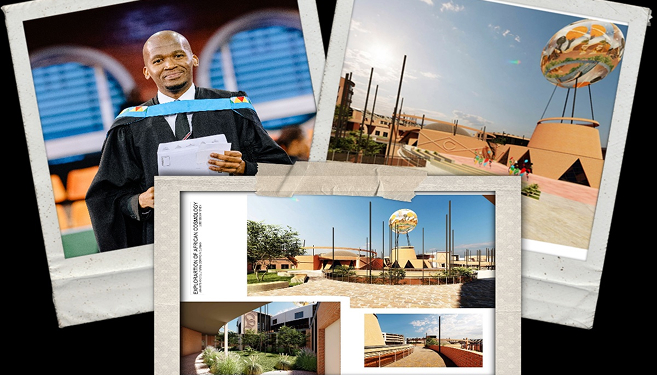
Master of Architecture graduate Mr Mkhuseli Myeni sees architecture as more than form and function. To him, it is memory, meaning and a medium for psychological and cultural liberation.
In his evocative dissertation, “Exploration of African Cosmology Through Built Form: An Arts and Cultural Centre in Durban”, Myeni charts a path back to indigenous identity through the bricks, beams and breath of space. Supervised by Dr Majahamahle Nene Mthethwa, the study positions architecture as both a spiritual and social tool – one that can challenge colonial imprints and reconnect communities to a deeper cosmological truth.
‘Frantz Fanon once said that the psychological self-liberation and the resultant development of Africans lies in their own definition of cosmology. Architecture becomes an external expression of this internal identity – it’s a vessel for values, dreams and ritual,’ he reflects.
Myeni sees the legacy of apartheid not only in urban design, but also in the spiritual and emotional disconnection it left behind. ‘Apartheid didn’t just separate people physically – it severed them from their cosmological roots. That disconnection leads to social decay, which is reflected in urban unrest like Fees Must Fall and the 2021 riots. The city becomes a site of unresolved trauma,’ he explains.
In response, his proposed arts and cultural centre in Durban is conceived as a living story – one that honours ritual, rhythm and return. Inspired by Bantu-Zulu architectural grammar, such as circularity and symbolism, the design leads visitors through a “rite of passage” to rediscover self, community, and cosmos. The centre’s heartbeat is Ubuntu, a philosophy of shared humanity. Spaces are designed for gathering, healing, and celebration: amphitheatres for storytelling and traditional dance as well as a dome-like theatre for projecting cosmological visuals and oral teachings.
A powerful feature is the reinterpretation of indigenous forms such as the uguqa (dome) and Uround (circular mud hut), reimagined using modern materials. ‘The thatched dome still triggers spiritual recognition in the Bantu-Zulu. It’s more than a form – it’s a feeling. Inside that dome, we showcase community-developed symbols and digital performances. It’s like entering the universe through your own cultural lens,’ he adds.
Throughout the centre, symbolic patterns- fractals, chevron motifs, and circles – speak to African cosmology. It also houses a themed library, a makerspace for digital storytelling, as well as multipurpose halls for music, ceremony, and community life. ‘Every corridor, every courtyard, is intentional. It asks: Who am I? Why am I here? How do I live in harmony with others and nature?’
At its core, Myeni’s project is a call to re-sacralise African space. ‘Culture – and now cosmology – is being used globally to revitalise postcolonial urban centres. It’s time we did the same. Not with nostalgia, but with bold, intentional design rooted in who we are,’ he notes.
Reflecting on his journey, he expresses deep gratitude: ‘I’m thankful to my supervisor, Dr Majahamahle Nene Mthethwa, for guiding me in shaping complex ideas into a clear architectural language; to my family, especially my mother and father, for grounding me in values that inform my work; and to my mentors, peers and community elders whose stories and support helped me build more than a dissertation – a vision of home, identity and possibility.’
Myeni hopes the next generation of African architects will continue to ask bold questions, root their designs in cultural truth and imagine built forms that heal, inspire and transform.