

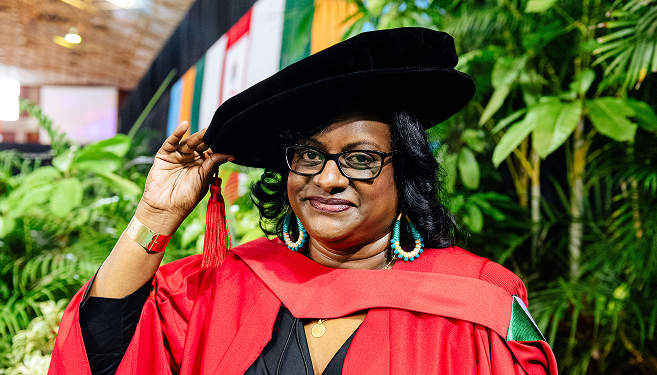
Dr Beverly Vencatsamy, a longstanding staff member in the School of Religion, Philosophy and Classics at UKZN, has been awarded her PhD in Religion and Social Transformation. Her study, “Religion as Agency: The Impact of Curriculum Structure and Teaching Approaches on Student Learning in Introductory Religion Modules” has been praised by examiners as ‘undeniably bringing new, nuanced and decisive scholarship’ to the fore.
Vencatsamy’s PhD by publication, which includes three peer-reviewed articles, makes a compelling contribution to the scholarship of teaching and learning, both nationally and globally. By drawing on more than a decade of experience in Religious Studies, her research interrogates the deep-rooted pedagogical structures shaping how religion is taught and learned in the South African classroom, particularly in introductory modules.
‘Inheriting modules like Introduction to Religion, I often felt constrained. While the content was comparative and contextually grounded, the structure discouraged student agency. Students memorised rather than questioned. That deeply troubled me,’ she explained.
Her academic curiosity led her to examine international shifts away from the traditional World Religions Paradigm, with its often rigid, comparative categories, towards thematic and contextually relevant models. These alternative pedagogical approaches resonated with her vision of creating spaces where students, particularly in a diverse society like South Africa, could bring their lived experiences into the classroom.
‘Foregrounding “religion as agency” allowed me to reframe students not as passive recipients of knowledge but as active meaning-makers. They come into class with complex, often deeply personal relationships to religion. Acknowledging that enables richer, more reflective and inclusive learning.’
As a UKZN staff member, Vencatsamy found that her insider perspective strengthened the study because she was able to draw on years of classroom engagement, institutional knowledge, and student feedback. ‘I saw patterns across modules. I saw where students disengaged, often because the curriculum didn’t speak to their realities. That pushed me to rethink how and why we teach religion the way we do.’
Her work explicitly addresses the national call for decolonisation in Higher Education. Rather than simply inserting local content into existing frameworks, her research advocates for fundamentally rethinking how curricula are structured and how teaching takes place. She asserts that decolonisation is about questioning the architecture of knowledge itself, letting students co-create knowledge, grounded in their contexts.
Choosing to complete her PhD by publication was a strategic and empowering decision for her. By publishing as she researched, she tested her ideas in real academic debates. In doing so, she affirmed the importance of critiquing colonial legacies and embracing thematic, inclusive teaching.
Among her recommendations for effective undergraduate Religious Studies pedagogy are constructivist approaches that prioritise student agency, thematic designs that tackle real-world issues, and dialogical classroom practices that promote reflection over rote learning. ‘Religion isn’t an abstract theory – it’s a lived, evolving and often contested reality. The frameworks we use shape students’ ability to relate to their own traditions. Many found non-Western religions positioned as “lesser”, and that’s unacceptable in a post-apartheid educational system.’
Reflecting on her academic evolution, she views teaching as both practice and scholarship. She believes that teaching is not just about content delivery, but rather about nurturing critical thinkers who can engage with knowledge as citizens of the world. Her hope is that fellow educators take her work as a call to critically re-examine how they teach and what assumptions underpin their curricula.
Vencatsamy’s achievement is deeply personal. ‘It affirms my commitment to my students. It honours the many conversations, frustrations, and insights we’ve shared over the years. As a staff member and an educator at UKZN, this PhD allows me to contribute to the kind of Higher Education I believe in – one that is inclusive, critical, and transformative.’
Her research supervisor, Dr Heidi Matisonn, commended the work as ‘important and timely,’ affirming Vencatsamy’s place as a leading voice in reimagining Religious Studies education.