

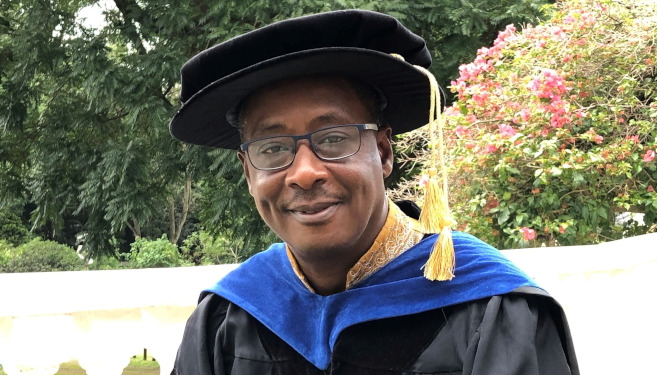
Professor Johannes John-Langba from the School of Applied Human Sciences, College of Humanities, presented his inaugural lecture entitled: Replicate or Don’t Replicate? Making a Case for Scaling the Utilization of Replication Research Methods in Social and Behavioural Research in Africa.
Having lectured at several international universities, John-Langba joined UKZN in 2017 where his research areas include social dimensions of health and disease, sexual and gender-based violence, social media use and psychosocial wellbeing, migration and health, mental health, substance use, and family wellbeing.
Inaugural lectures mark an important milestone in an academic’s career and John-Langba chose to celebrate his by dedicating it to the memory of his parents who instilled the value and virtues of education in him from an early age. He shared, ‘Even though my mother was not privileged to receive a formal education, she knew the importance of it and taught my siblings and I the entire English alphabet before we started school’. This determination fuelled his hunger for knowledge and fed his desire to pursue an academic career which has been rich and rewarding.
Replication research is broadly defined as conducting an original study again, be it using identical procedures or by making certain changes to the conceptualisation and methodology to test the findings of the original study. John-Langba examines the rationale and significance of replication research approaches in the social and behavioural sciences as well as some of the critical concerns related to replication methodology and its applicability in the African context, including the challenges of sameness.
He asserts that African countries need to engage more in replication research methods for evidenced-based policy and practice if they are to accelerate achievement of the sustainable development goals (SDGs), particularly those related to addressing social and behavioural issues. He also argues that ‘as Africans, we do not need to wait for grant funding from the North to engage in proof-of-concept studies when in fact, existing evidence could be replicated in different contexts in Africa.’
Through his lecture, he aimed to engage in evidence-informed advocacy for more use of replication research in the social and behavioural sciences in Africa.
In summary, John-Langba asserts that there is a strong case for replication studies in social and behavioural sciences in Africa. However, its current use is limited and he contends that for this to change, there must be a shift in the thinking that single studies are sufficient to inform policy and practice. Importantly, he adds that for replication methods to achieve greater success, various stakeholders must be involved in its promotion including national and local governments, funders, researchers, Higher Education Institutions, and professional societies and associations.
‘Replication studies hold huge promise to inform Africa’s development agenda and achievement of the SDGs and I hope that my lecture is a step in that direction,’ he said.
‘I would also like to thank my family and colleagues for their support and UKZN, a university which truly nurtures African scholarship.’
Professor Nhlanhla Mkhize, Deputy Vice-Chancellor and Head of the College of Humanities congratulated Professor John-Langba on this momentous occasion and pointed out that his lecture had highlighted the role that can be played by replication designs in intervention studies in mental health and gender-based violence.
Mkhize also made special mention and noted his sincere appreciation of Professor John-Langba’s role as Director of the Doctoral Academy that was established in 2019 to highlight the quality of doctoral training at UKZN.