

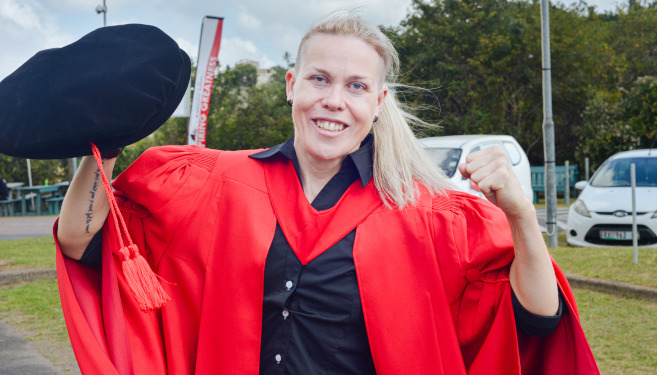
PhD graduate Dr Janine-Lee Upton has broken new ground in a study empirically detailing the precipitating features that explain why and how women not only possess the potential to – but also overtly – change the expression of their sexuality as they age.
Understanding Perceptions of Sexuality in Peri-menopausal Women: A Qualitative, Discourse Analytic, Case Study of Formerly Hetero-Exclusive Women in KwaZulu-Natal, South Africa, is the title of Upton’s study which is built on the theoretical understanding of women’s varied sexual expression in the context of South African-lived experiences, constructed out of a unique socio-political and racial history.
Explaining the reason for her research area, Upton, who graduated at UKZN’s Spring Graduation ceremonies in September, said: ‘My partner planted the seed as she had experienced a later-in-life switching in the gender of her primary partner. As a result, I increasingly reflected upon this trend and started observing it more consciously with friends and family. Subsequently, upon talking about this phenomenon, other women expressed either personal experience of this or knew of someone who had discontinued heterosexual expressions of their selves. “I know of a lady who…” became a commonplace response from people.’
Upton said despite the dearth of empirical literature on later-in-life changes in the expression of sexuality, she wanted to create an understanding unique to the South African experience and give a voice to women experiencing a phenomenon they otherwise would consider pathological, which leaves them feeling alone in their experience. ‘There persists, at the nexus of our everyday experience, the intersection of sexual, gender, political, religious, and other identities in ways that are expressed but never really reflected upon, or disentangled in ways to create an essentialist understanding of how they came together in universal patterns of sexual expression.’
Her supervisor Professor Rozena Maart described Upton as a diligent, hardworking and consistent researcher and student. Maart said the study is one of a kind and grounded in the existential experience of her lived experience.
‘We both have a commitment to doing work that addresses gender critically and by this, I mean not simply as a day-to-day construction but as an area that needs investigation of components that are under-researched and often not spoken about,’ said Maart.
Upton said while it’s commonly understood that women possess a potential for sexual fluidity, she wanted to understand why the expression of that changes over time and how women, with seemingly diverse racial identities, came to express their sexualities in common ways over time.
She said the rationale was to inductively build a theoretical understanding of women’s varied sexual expressions extending across their lifespan given the dearth of literature on the subject and to create a contextual understanding unique to South African women. As such, Upton attempted to include diverse multi-racial perspectives within the chosen sampling frame in an effort to capture the potential intersectional differences and nuances in exacerbating inequality to understand the varied experiences and expression of sexuality over time, and across South Africa’s vast socio-political and racialised history.
However, despite numerous attempts to identify and include Indian women in the study, she found that there were no known willing or eligible participants who volunteered participation. This within itself was a concerning finding regarding the persistent silence and isolation within which women grapple with their own sexuality and sexual identity as they remain subjugated by heterosexualised norms and patriarchal hegemony.
Upton’s study focused on formerly hetero-exclusive women and found that through a process of identity orientation (innate sexual orientation), identity confusion and pathology (caused by socialising agents), external identity imposition (as others impose upon you who you “should” be, and what you “should” do with your body), to disorganising principles of self (where you have no one to identify with other than heteronormative couples), women give up their identities to embody heterosexualised norms. This cycle of becoming something and someone you are not (false self), to eventually reach a stage of rebecoming your true self was a theoretical model developed by Upton unique to understanding varied sexual expression in women over time.
This model explains why women who have an innate same-sex attraction experienced earlier in life come to perceive their same-sex attractions as deviant in ways that lead to the suppression of their true selves and most naturally occurring desires due to societal agents and dominant heterosexual discourse, together with the absence of role models demonstrating and normalising same-sex partnerships. This deviance causes the abandonment of the true self in a manner that results in a disconnection between the true and false self in ways that lead to “soul death” or physical and emotional exhaustion. Increasingly, as women move further from their true selves to adopt an inauthentic false self that is compliant to societal norms, they experience more trauma, and increasingly deploy defence mechanisms as a means to protect the integrity of the true self.
The study uncovered critical findings of women’s experiences with evolving sexuality and identities throughout their lives within a heteronormative and patriarchal society. Participants with an innate, persistent same-sex orientation felt at conflict with societal norms which lead to confusion and feelings of difference. The disconnect between inner feelings and outer experiences was reinforced by traditional and entrenched societal agents upholding customary gender ideals, such as family and religion. Participants feeling the pressure to conform, suppressed their primary sexual orientation and faced ensuing identity confusion. What resulted was a false, socially-sanctioned self, empty, hollowed-out and devoid of the ability to feel pleasure or satisfaction, imbued in feelings of trauma, guilt and shame.
‘Trauma was evidenced by all women within the research cohort who had all abandoned their true selves in pursuit of an internalised heterosexualised ideal. Freudian psychoanalytic concepts relating to defence mechanisms were indicative of an ego formation in response to perceived threats to the self, and therefore a symptomatic tell-tale that there still persists covert pressures to conform to heteronormative ways of being in a manner that entails a sacrifice of the self.’
Women thought they had no other choice but to seek out validation of the self but to conform to heteronormative ideals, traumatically and increasingly disconnecting from their real self throughout their lives until a precipitous stage in life where they can no longer tolerate living within a falsely constructed state. This stage coincided with the onset of perimenopause. Upton says women navigating through the complexities of perimenopause, experience a profound transformation as a result of various factors characteristic of this phase in life. Peri-menopause offers women a positive opportunity for growth and self-assertion.
By this stage women, are exhausted by the deployment of failed and corrosive ego defences, coupled with financial freedom, older children requiring less “mothering”, increased self-confidence and a positive self-concept, and a strongly evidenced me-focus as women turn from focusing their energy on others, to focusing on themselves. Peri-menopausal women clearly demonstrated a refusal of societal norms and a growing intolerance towards patriarchal expectations. Within this phase of life, women feel compelled to distance themselves from their false selves and embrace their genuine identities, rebecoming and asserting their reconstituted true self. This finding within itself heralds menopause as a positive and empowering experience, rather than traditionally negative biomedical restrictions placed on this phase of life for women.
Maart praised Upton for her groundbreaking dissertation. She said: ‘I have experience and expertise in Gender and Sexuality Studies, as well as Critical Race Theory, and whilst she did not work in the actual discipline per se, she had an interest and had clearly done her homework. Gender is cross-cutting so it is clear that she had done work in the area.’
She said Upton is an everything or nothing person and, in this regard, they both have a lot in common. ‘Janine is fearless, which does not mean that she is not vulnerable at times as this kind of work demands a lot of us personally, emotionally, and psychologically. Janine has handled herself very well.
‘The examiners praised her work, and commented on her good the overall dissertation was at the level of cum laude and summa cum laude, which unfortunately we do not award at doctoral level. She has made all of us at the University very proud, and certainly her family, friends and colleagues. Her work is an asset to our community of scholars and to the country, without a doubt.’
Upton hopes to extend this study to men, and wants to explore how they experience the pressures identified in this study in ways that are similar, shared or deviant, and what leads to a furthered delay in the expression of their sexuality, and more so, the ramifications of not doing so.