

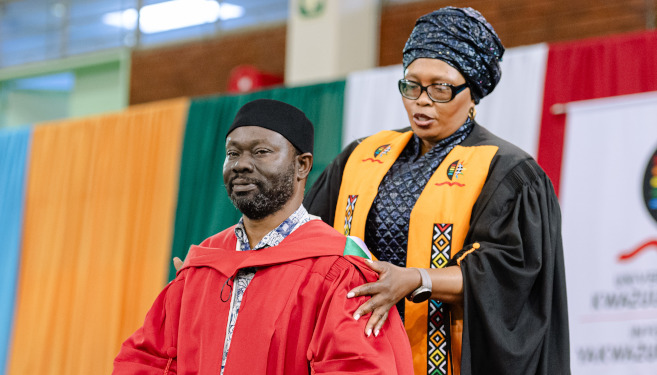
In a study described as “groundbreaking” and a “first-class piece of PhD work”, the intersection of gender, religion, and migration among Malawian Chewa and Yawo Muslim women in Durban in the last three decades formed the basis of a PhD study by Dr Joseph Yusufu Mbalaka with the aim to fill gendered gaps in the history of southern African migration.
Mbalaka notes that people moving inside a state as well as from one country to another have come to be seen as the primary element of globalisation in the 21st century. Immigrants relocate in the quest for employment or other economic opportunities, to be with family, or to improve their education. Others move to avoid violence, persecution, terrorism, or human rights violations; while others move in response to the detrimental effects of climate change, economic hardship, and natural disasters, among other factors that have been highlighted as key drivers of worldwide migration trends.
‘The study highlights the opportunities, socioeconomic, and cultural obstacles they have faced and continue to confront after arriving in South Africa. As a result, a gendered “history from below” emerged, giving voice to the voiceless in a nuanced way. Gender, social history, oral history, and transnationalism theory were predominantly used to investigate women’s lived experiences. These theories contributed to a better understanding of how women immigrants work in social domains that cross geographic, political, and cultural boundaries, as well as how they assimilate into host countries,’ said Mbalaka.
‘Migration, both domestic and international, has increased globally. As a post-apartheid society, South Africa has attracted immigrants from various countries, including women. However, despite this, the experiences of Malawian women have been understudied in African historiography. I therefore aimed to fill the gendered gaps in the history of southern African migration.’
Cognisant of conducting scholarly research without being intrusive of the inner sanctum of Chewa and Yawo Muslim women in Durban, in its complexity, Mbalaka managed to “paint the big picture” of women and migration while honing in on them. Key findings include the role of gender in determining migration patterns and experience in the host society. The study argues that women were more likely to be abused than men. Male migrants tended to earn higher wages than their female counterparts; conversely, female migrants sent more money home.
‘Women’s agency in the face of multiple difficulties is discussed. Women are not helpless victims but try to shape their lives. Despite the problems, the study concludes that migration allowed some women to gain independence and autonomy,’ said Mbalaka.
Described as a timely addition to the field of “feminisation of migration” research which explores the trend-change in gender roles within a society, group or an organisation in favour of an emphasis on the female, Mbalaka also discovered that the feminisation of migration in Malawi is causing high rates of divorce, as women seek better prospects in South Africa.
By highlighting the importance of “history from below”, Mbalaka hopes that his study will assist to inform policymaking and assist in considering various other aspects of migration, including resilience, Africa in Islam, communal experiences, pan-Africanist perspectives, memories, culture, Durban’s history, and labour practices – all within a historical context.
Thanking his supervisor and staff of the History department at UKZN who were on hand for their expertise and support, Mbalaka dedicated his studies to the Chewa and Yawo Muslim women, as well as his family and friends for helping him on his journey.
Describing himself as a lifelong learner and researcher, Mbalaka is interested in the history of east, central and southern Africa and plans to continue in academia.